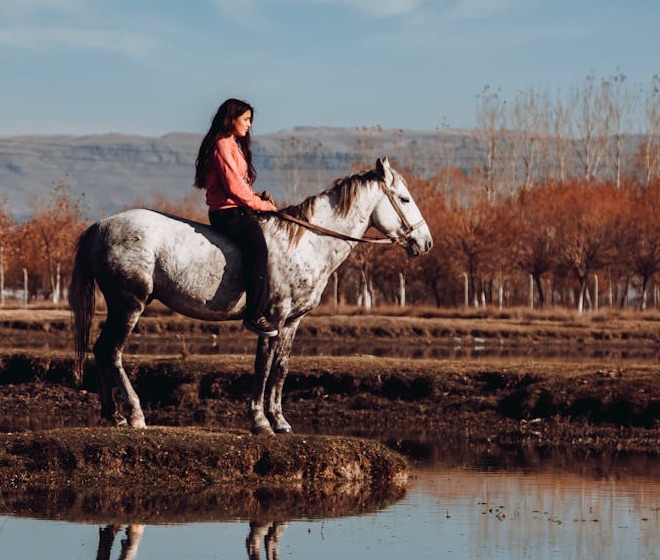
You can lead a horse to water, but you can’t make it drink. This can be said of my dog, Rocky, as well. I went on a hike with him a couple days ago. I brought plenty of water and a bowl. Even though it wasn’t too hot, Rocky’s black fur really soaks up the sun’s heat. We stopped frequently, and I poured water into his bowl, but each time, he ignored the water. His tongue was hanging out so far, it was practically dragging on the ground. Finally after about the fifth stop, he lapped up the water eagerly.
“For it is God who is working in you both to will and to work according to his good purpose.” (Philippians 2:13, CSB)
God’s purpose for me is good. Perfect in fact. Like drinking water on a strenuous hike.
And yet, I often try to do things my way. Like Rocky, I think I know better. I don’t have time to slow down and lap up some water. My priorities seem better and more important.
But if I stop and listen to God, He will work in my heart so that I want to, and am able to, obey His will. Spending time with God fills me with His Spirit so I can see the wisdom of doing things His way, the better way. The trail will still be there, but by obeying God, I will be much better equipped to keep climbing.
Dear God, thank you for your wise guidance. Remind me to continually seek your will. Fill me with your Spirit so I make wise choices and step forward into your good purpose for my day.
When my nephew was accepted into the college he really wanted to attend, the first thing he did was buy a sweatshirt bearing the school’s name, logo, and colors. He wore it proudly everywhere he went. Since then he’s acquired an entire wardrobe of university-themed items, from socks to hats, shorts to ties. Everyone can clearly and immediately see where he belongs.
“Therefore, as God’s chosen ones, holy and dearly loved, put on compassion, kindness, humility, gentleness, and patience,” (Colossians 3:12, CSB)
When I accepted Jesus’s gift of salvation, I became a follower of Jesus. I belong with Jesus. I was adopted into His family. I was made holy. And I am dearly loved.
Instead of school colors, God has some important items for me to wear. They aren’t made of cotton, wool, or polyester. They aren’t stitched, sewn, or printed.
As God’s dearly loved and holy child, I am to wear the family character traits of compassion, kindness, humility, gentleness, and patience. I must pull these on every morning so that people know whose I am and where I belong.
Dear God, remind me to put on our family colors every morning. Show me when my hat of compassion has slipped or my shirt of patience has become worn and stained. Forgive me for choosing to remove my sweater of humility from time to time. Dress me fully in your love today so I am a beacon for your kingdom in all my interactions.
When people get married, they enter a covenant. Promises are made. Sometimes they commit to standard, boiler-plate vows like, “I take you as my lawfully wedding husband, to have and to hold, from this day forward, for richer or poorer, in sickness and in health, until death do us part…” Other times personalized vows are written and recited as part of the ceremony.
My husband claims that I promised to laugh at all his jokes, as part of my wedding vows. What I actually said, much more poetically, was that I would join him in laughter when he found joy.
Whatever the specific promises made, when it comes to a marriage, none of it matters as long as one thing is present: love.
The vow to love overrides all other vows. If I love my husband, I will automatically join him in laughter when he finds joy. (I will probably laugh at his jokes too.) If I love someone, any vows to stay faithful are included as part of that love. Love doesn’t care about wealth or poverty, sickness or health. Love just loves.
God made a covenant with His people, like a marriage. Many vows were made. The Israelites broke them all. So God made a new covenant and sent Jesus to help us hold up our end. When asked which vow was most important, Jesus quoted this verse:
“Love the Lord your God with all your heart, with all your soul, and with all your strength.” (Deuteronomy 6:5, CSB)
Love is the only command that matters. If I love God, I will strive to do things that please Him, not things that upset Him. If I love God, I will spend time getting to know Him. I will read what He wrote, appreciate His beautiful creation, admire His wisdom, and love who He loves.
Dear God, thank you for wanting to be in a covenant relationship with me. There doesn’t seem to be much in it for you, while I receive salvation and eternal life. Thank you for providing all the love that our relationship requires, and even more love so that it overflows into all my relationships. Teach me how to be generous with your love.
The modern idea of a weekend, and the 5-day work week, has been around for a hundred years or more, but the idea of a “day of rest” is as old as dirt. That was God’s idea. He decided that any hard-working creator, Himself included, should take a day to rest and appreciate what had been created. So He created everything in His six days, and rested on the seventh. And the Sabbath was born.
God considered this Sabbath to be so lovely that He included its protection among His first commands to the Israelites: remember the Sabbath and keep it holy.
I grew up in a culture that called Sunday the Sabbath day. We did things like go to Sunday school and church. Followed by lunch with the family. Then, my parents usually took the “day of rest” part literally and napped. We could play but needed to do so quietly.
I remember observing the Sunday experiences of some of my friends who didn’t attend church and feeling envious. To them, Sunday was just like Saturday where they could sleep in, watch cartoons, and play all afternoon. No need to wake up early, get dressed up, and sit around listening to boring sermons all morning.
And yet the practice has stuck with me. I attended church on Sundays for most of my adult life in every city I moved to. While I was single, and after I got married. A great variety of churches in a great many places. I protected my Sunday mornings.
But the pandemic broke my habit.
I still attend church most Sundays, but because we moved to our current town during the pandemic, the church I attend is live-streamed into my living room. It is a local church, and I could absolutely attend in person now, but do I need to?
“Then he told them, ‘The Sabbath was made for man and not man for the Sabbath.’” (Mark 2:27, CSB)
The answer to my question lies in my exact reasons for not attending in person. And also in how else I am spending my Sabbath.
Jesus disagreed greatly with the church leadership of his day about the Sabbath. Jesus said the Sabbath is supposed to be a good thing where God is honored and people are blessed and refreshed.
The religious leaders created their own rules about what was and was not allowed on the Sabbath. Those rules ignored the needs of people. They cherished the power their rules gave them more than they cherished God. Jesus said if the rules were so onerous that a person couldn’t even seek healing, they were doing it wrong. Many conflicts ensued, eventually leading to Jesus’ crucifixion.
Am I honoring God when I worship Him from my couch on Sundays? Sometimes. Does God feel like a priority or an afterthought? Can I bless any people from my couch?
Could I honor God better in the pew of a church surrounded by other people who are worshipping Him? Perhaps. Would I have more opportunities to bless and be blessed by others there? Probably. Maybe there’s a third option for that?
While God can be honored from anywhere, perhaps I need to give myself the clearest path to doing so and not just giving in to my lazy nature, saying couch church is good enough.
Dear God, thank you for your desire to bless your people with the refreshment of your presence as we worship you. Teach me how to properly spend my sabbath days. Show me the right ways to honor you with worship and acts of mercy, compassion, and kindness during an intentional break from my regular daily schedule.
At the start of the Covid-19 Pandemic, there was a short period of time where being sequestered at home felt novel and a little exciting. We dreamt of new hobbies to start, existing projects to complete, and old friends to catch up with as we dabbled in video chatting.
But the novelty wore off quickly as time dragged on. Tempers flared as anxieties crept in. Our tiny bubbles felt claustrophobic. Some seized the opportunity to profit from the fear and isolation, making matters worse by sowing distrust, spreading misinformation, and deepening our divisions.
It turns out we don’t do well with isolation. They know it in prisons (punishment of solitary confinement) as well as on playgrounds (punishment of having to skip recess to pound erasers). We only thrive in community.
As much as I like my independence, I need other people. I need their company, their humor, their different ideas, their encouragement, their love. I need other people to hold me accountable, to help me when I’m hurt, to keep me humble, to acknowledge my achievements, to inspire me, and to warn me. Some days, I just need to be seen by other people to know that I exist.
God created humans to need each other. Obviously He preferred community and cooperation over isolation and independence. He, Himself, is a Being of community, existing in three persons.
So even when it feels challenging, it’s vital to focus more on what unifies us than what divides us. We need to strengthen bonds of community instead of building walls of separation. We need each other — all of God’s children. United we stand. Divided we clearly fall.
Dear God, thank you for giving us the need and desire for community. Teach me how to see ways to connect instead of reasons to pull away. Help me build bridges instead of walls.
In the animal kingdom, the primary driver of behavior is survival. Animals do everything they can to keep on living another day. They focus their energy on those things and only those things.
With a glaring exception: motherhood. (And in some cases, fatherhood.)
Animal mothers spend vast resources protecting, feeding, and training their young even though this threatens their own survival. God built animals with this instinct so entire species could survive, not just individual animals.
In humans, God built something on top of motherhood. He created us in His image, so He built us with love.
Sure, we naturally seek our own survival and that of our offspring. But we also have the capacity to reach beyond that to help friends and even strangers. We volunteer time and money for people we will never even meet. When we see someone in pain, we want to help stop that pain, even if it causes us a little more pain.
“Don’t neglect to do what is good and to share, for God is pleased with such sacrifices.” (Hebrews 13:16, CSB)
That is the beauty of being God’s child, the beauty of love. It is a sacrifice. It goes counter to my animal, survival instinct. But it’s a sacrifice that makes the world a little more like Heaven. And a sacrifice that makes God smile.
Dear God, thank you for all you have blessed me with in this life. Guide me today in the best, most loving and effective ways to share those blessings with people in this world who are hurting. Thank you for loving me and for giving me a capacity to love.
Many Sci-Fi and Fantasy stories have been written where words have power. (A Man of His Word series by Dave Duncan or The Wizard of Earthsea by Ursula K. Le Guin, among many others.) Magicians today would also have you believe at least some of their power comes from words like abracadabra and presto-changeo or something.
Words actually do have power of course, but not the way these stories or magicians propose.
Words I speak have the ability to make someone’s day much better, or much worse. They can start a new friendship or damage an existing relationship forever. Words from a powerful world leader can start a war, or end one. Words do have power, and I should use them carefully.
However, the power of words from my human mouth are quite limited. Someone must hear them, in the right circumstance. There is no power in my simply uttering them into the void.
Words from God’s mouth have ultimate power. He created everything that exists simply by uttering a few world into the void. There was no one to hear Him say, “Let there be light.” And yet light indeed appeared. The Big Bang perhaps. Boom. Light. Worlds. Galaxies. Universes.
Just with a Word.
“In the beginning was the Word, and the Word was with God, and the Word was God.” (John 1:1, CSB)
Jesus is the Word that created everything. He later wrapped Himself up in human form to come teach us more clearly about God’s power. His love. His Word.
Jesus calmed the storm with a word. He healed countless diseases with words. He killed a tree with a word. He raised Lazarus from the dead with a word.
God’s power is complete. It is beyond my comprehension. I can rely on His Word because His Word has power. Real power. When He speaks, His will will be done. Without fail.
Dear God, thank you for your creation and for the reminder of the completeness of your power. There is nothing else as powerful, and no one to fear when I am in the shadow of your wings. With a word, you can create or destroy. Nothing can stand against you. Remind me to use my own words and power carefully, to love and not destroy.
I’m not an alcoholic, for which I am very grateful. However, being addicted to sugar, I can easily imagine the feeling of need, sometimes all-consuming, for some substance such as alcohol. I know it is not at all the same, but I’m just saying I have a vague idea of what an alcoholic or drug addict suffers daily.
My addiction, sugar, is socially acceptable, and if I fall off the wagon, it tends not to destroy my life. When I give in to my cravings, I suffer only mildly, and the damage is gradual with only long-term health detriments.
Falling off the wagon with drugs and alcohol is very damaging almost immediately. The effects can be sweeping and dramatic — loss of a job, a relationship, a home.
We all have struggles, including with our faith. Life is hard, and finding ways to cope is a constant quest. When I put my trust in something other than God, I am going to be let down. But sometimes those other things seem more present and available than God does. The devil makes sure they are glamorous, enticing, and easy to reach for.
Judgment in those circumstances doesn’t do anyone any good. Compassion and mercy is what God offers. And it is also what I, as His follower, am called to offer.
Dear God, thank you for your mercy on me when I choose to find comfort in things this world offers instead of turning to you, the only true source of strength and love and comfort. Remind me to extend the same compassion, forgiveness, and mercy to others who waver in their faith, giving in to the panaceas of this world. Forgive me for the judgment I feel. Fill me instead with your love.
Calling an opponent soft on crime is common political jargon intended as an insult during election seasons. When people hear it, they are meant to envision thieves and murderers breaking into their homes with no repercussions, a frightening lack of justice.
Is that the same as mercy? Is mercy weak? Is mercy a lack of justice?
God is called both just and merciful in the Bible. How do these two things co-exist?
Justice means laws and rules are enforced. Appropriate and timely punishment is given to people who commit crimes.
Mercy is the choice not to give that punishment to the criminal. Not a failure or inability to do so, but intentionally choosing not to.
God is both just and merciful to His children. He did mete out justice for all of our crimes. And the punishment was very harsh. It called for death. However, God is also merciful because He chose not to give that punishment to the criminals, us. He delivered the punishment instead to His own Son, Jesus. Justice was served while we received loving mercy.
“Learn to do what is good. Pursue justice. Correct the oppressor. Defend the rights of the fatherless. Plead the widow’s cause.” (Isaiah 1:17, CSB)
Now that we have seen how it’s done, God tells us to behave the same way. We should seek justice for those who can’t find it and offer mercy at every turn. God’s ultimate justice will prevail, and His mercy as well.
Dear God, thank you for your amazing gift of mercy. Thank you also for your promise of justice — although I’m glad you didn’t make me pay the price for my sins. Teach me how to care for those who lack justice as well as be merciful to those who deserve punishment.
Many times in my life I have been faced with a situation I felt ill-equipped to manage. I am currently in the midst of one now. I have been asked to help my parents sell a parcel of land they have owned for nearly 60 years. There are a lot of variables, even more unknowns, and I live about 2000 miles away.
Life is full of confusing circumstances and challenging responsibilities. It’s easy to feel helpless and hopeless.
“Now if any of you lacks wisdom, he should ask God — who gives to all generously and ungrudgingly — and it will be given to him.” (James 1:5, CSB)
Followers of Jesus are not immune to the trials of life. However, we do have the Creator of the Universe in our corner. There’s no need for me to fight my fight blindly, jabbing my ineffectual fists into the dark hoping to hit the mark.
God says, “Just ask me. I’ll give you what you need to figure it out and do the right thing.”
When I trust God, He promises to provide wisdom. That wisdom may come in the form of an adept realtor or some other expert. Or maybe a friend, an overheard conversation, or just an inspiration directly from God. No matter what, when wisdom is asked for, wisdom will be granted. God said so. Maybe it’s time I asked.
Dear God, thank you for your promise to generously bestow wisdom upon me when I ask for it. I am asking. I need wisdom today.